
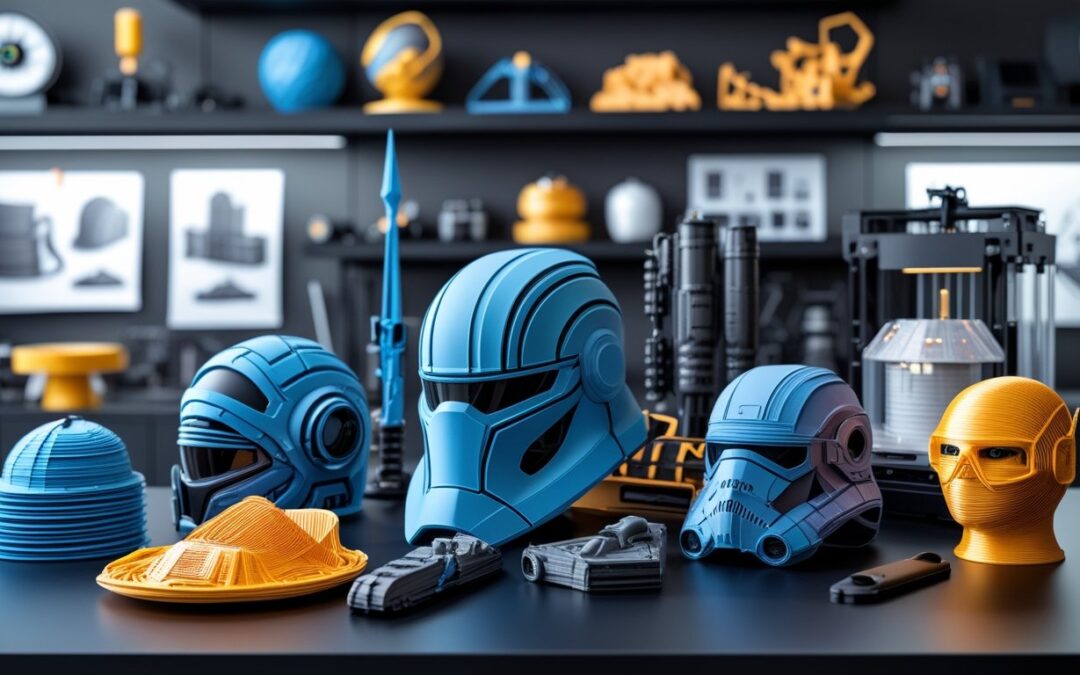
3D printed movie props are changing the way productions approach design, speed, and precision. From blockbuster sets to indie passion projects, filmmakers now have the power to quickly produce highly detailed props that meet exact specifications.
With Voxel Magic, creators can access professional-grade 3D printing services with fast turnaround and expert support. This partnership ensures your props match your vision and production timeline—without compromising on quality or realism.
In this article, we’ll explore how 3D printed props are reshaping film and design. Keep reading to learn how they’re made, the software and materials behind them, and how you can create your own.
Understanding 3D Printed Movie Props
3D printing changes how movie props are made by using digital models to create precise, detailed objects quickly. This technology replaces many traditional methods, offering new ways to build complex shapes and exact replicas.
You get faster production with sharper results that meet the high standards of modern film.
What Are 3D Printed Props
3D printed props are physical models created layer by layer from a digital design. They can be anything from weapons, gadgets, to intricate set pieces.
These props are made using materials like plastic, resin, or metal, depending on the look and durability needed. Because 3D printing builds items digitally, you can create exact copies and share files instantly.
This means you can adjust designs without starting over. Props can also be printed on demand, minimizing waste and storage costs.
For movie makers in NYC, quick local 3D printing means less waiting and more agility during production.
Evolution of Prop Making in Film
Earlier prop making was slow and required many hands-on steps like carving, molding, and painting by artists. This made complex props expensive and time-consuming to produce. Physical models were limited by the artisan’s skill and the materials available.
With 3D printing, this process has been streamlined into digital design, rapid prototyping, and fast production. You can now test and modify props quickly on-screen before final printing. The ability to print fine details and complex interiors was impossible before.
NYC studios gain a local advantage by working closely with 3D print partners who understand tight schedules and creative demands.
Benefits of 3D Printing Over Traditional Techniques
3D printing saves time by producing props in hours or days versus weeks. It cuts costs by reducing materials and labor, especially for prototypes or limited runs.
You also get higher precision, with exact dimensions and surface details that hold up under high-definition filming. Unlike traditional methods, you can replicate the exact same prop multiple times without differences.
This helps with continuity and merchandising, where fans want “as seen on screen” replicas. Locally, fast turnaround helps accommodate last-minute changes during shooting, keeping your production on track without sacrificing quality.
Indie Film Use Cases: Cost, Speed, and Access for Smaller Productions
According to Raindance in “Revolutionising Indie Filmmaking Through 3D Printed Props” (2024), independent filmmakers are increasingly using 3D printing to create professional-standard props without needing big budgets.
The article reports that 3D-printed prop pieces allow indie productions to iterate quickly, adjusting design, printing, and finishing. And to accomplish it in much less time than traditional sculpting or mold‑making.
Because props can be printed locally and on demand, indie creators benefit from lower storage costs and reduced risk when changes are needed in design or shooting plans.
Materials and Technologies Used
Movie props made with 3D printing rely on a mix of materials and printing methods. These choices affect how the props look, feel, and perform on set. Knowing the right materials and technology helps you get durable, detailed results for your project.
Common 3D Printing Materials
You will mostly see plastics used for movie props because they are lightweight and versatile. Polymers like PLA, ABS, and resin are popular for their ease of printing and smooth finishes.
Resin, especially, allows for fine details and sharp textures, which help props look realistic on camera. For more complex needs, studios combine materials like rubber-like polymers to simulate softness or flexibility.
Metals and composites are less common but are used for parts needing strength or a metallic finish. Using different materials in one print can give your props authentic weight and texture.
Popular 3D Printing Methods
Different printing methods serve different purposes for movie props.
- PolyJet printing lets you combine multiple colors and materials in a single object. This makes props that look finished without much extra work.
- Fused Deposition Modeling (FDM) is widely used for big, sturdy props. It stacks plastic layers and is fast and cost-effective.
- Stereolithography (SLA) and Digital Light Processing (DLP) use light to harden resin with high precision, perfect for tiny, detailed parts.
Your choice depends on the level of detail, size, and finish you need. Each method offers unique advantages for different prop designs.
Post-Processing for Movie Quality
After printing, props need finishing steps to meet on-camera standards. Post-processing includes sanding, painting, and sometimes adding texture or coatings. Sanding smooths layer lines left by the printer.
Painting uses specialized techniques to mimic metal, wood, or weathered surfaces. Some props undergo UV curing or clear coating to increase durability and shine. You can also combine 3D printing with traditional methods like adding fabric or metal parts.
Good post-processing turns a raw print into a prop that looks and feels real on set.
Designing Props for 3D Printing
Designing movie props for 3D printing requires precision and careful planning. You need to consider the accuracy of the film’s vision, choose the right software for modeling, and prepare files to ensure smooth printing. Each step shapes the final quality and usability of your prop.
Concept Development for Film Accuracy
Start with a clear understanding of the prop’s role in the story. Identify key details that define its look, size, and function on screen.
Reference concept art, film scripts, or other visual materials to capture essential elements. Focus on scale and proportions to match what filmmakers expect.
This helps maintain believability in close-up shots or action sequences. Collaborate with directors or designers when possible to clarify any uncertainties.
3D Modeling Software for Prop Design
Choosing the right 3D modeling software affects both your workflow and print quality. Programs like Blender, ZBrush, and Autodesk Maya are popular for creating detailed and complex prop models.
Blender excels at creating precise, adjustable meshes with a user-friendly interface, making it great if you need tight control over shapes. ZBrush offers advanced sculpting tools, useful for organic or highly textured designs.
Maya is strong in animation-ready models, helpful for props involved in movement. Your choice depends on the prop’s complexity and your familiarity with the tool.
File Preparation and Optimization
Once your model is ready, prepare it for printing by checking for errors like holes, non-manifold edges, or intersecting parts. Tools like Meshmixer or Netfabb can help you repair and optimize files to avoid print failures.
Simplify overly complex meshes without losing important details. This improves print speed and reduces material use.
You also need to consider the orientation of parts on the build plate—this influences surface finish and structural strength. Finally, slice your model correctly, setting layer height, infill density, and support structures based on the prop’s design needs.
Proper preparation ensures your print matches the intended look and holds up during filming.
Workflow for Creating 3D Printed Movie Props
Creating 3D printed movie props involves a clear, step-by-step process. You start with a design concept and move through prototyping with expert collaboration and strict quality control. Each stage ensures your prop meets both artistic and technical needs.
From Script to Prototype
Your journey begins with the script, where prop designers identify what’s needed for the story. You work with CAD software to build a detailed digital model.
This includes size, shape, and textures to match the director’s vision exactly. Once the model is ready, you export it as an STL or OBJ file.
This file goes to a 3D printer capable of producing high-precision parts, allowing you to create a physical prototype. Rapid prototyping helps you check the design’s fit and finish before finalizing. This saves time and money compared to traditional methods.
Collaboration Between Departments
Effective prop creation depends on close teamwork. You’ll coordinate with directors, art departments, and special effects teams to ensure the prop fits the scene and technical needs.
Designers share updates quickly, using digital files that can be adjusted based on feedback. Your collaboration helps avoid costly delays by catching issues early.
Quality Control in Prop Creation
Quality control means your prop performs well on set and looks authentic on camera. After printing, your prop undergoes a detailed inspection.
You check for surface details, color matching, and structural strength to meet the production standards. If needed, finishing steps like sanding or painting are applied to enhance realism.
Final tests verify the prop can handle use during filming. Quality control keeps every piece reliable, avoiding last-minute setbacks on set.
Iconic Examples of 3D Printed Props in Film
3D printing has transformed how movie props are made, offering fast, precise results for complex designs. You’ll find this technology behind key items in well-known films and TV series, where it shapes costumes, weapons, and detailed models.
Some designs have even earned industry awards for their craftsmanship and innovation.
Blockbuster Movies Featuring 3D Printed Props
Many blockbuster films rely on 3D printing to produce intricate props quickly and with high accuracy. Star Wars movies, for example, used 3D printing extensively.
Under expert supervision, teams created helmets, weapons, and costume pieces to maintain a perfect balance of durability and detail. Other hits, like Marvel superhero films, used 3D printing to build suits and accessories, enabling rapid prototyping and adjustments on set.
This process saves time and reduces costs while delivering realistic effects tailored to each character.
Notable TV Series with 3D Printed Elements
TV series with tight production schedules benefit greatly from 3D printed props. Sci-fi shows like The Mandalorian use 3D printing to create futuristic weapons and armor.
The method allows for quick iterations to meet the visual demands of evolving storylines. The fantasy series also uses printed props for magic items and helmets.
These parts blend seamlessly with physical sets, giving you a more immersive viewing experience. You get authentic, detailed props without the wait or expenses of traditional methods.
Award-Winning Designs
Several 3D printed props have earned awards for their design and impact. These pieces stand out for combining creative vision with manufacturing precision.
For instance, some props have won special effects and costume design awards, highlighting the role of additive manufacturing in storytelling. These award-winning props showcase how 3D printing enhances both artistry and production efficiency.
Challenges and Limitations
Using 3D printing for movie props offers many creative advantages, but it also comes with specific technical and financial hurdles. These factors affect how quickly and precisely you can bring your designs to life, and how well they fit within a production’s timeline and budget.
Technical Constraints
3D printing technology has limits around material strength, resolution, and size. Some materials used in printing aren’t as durable or flexible as traditional prop-making materials, which can impact how long your prop lasts during filming.
Printing very fine details or complex textures can be difficult, especially when working with lower-cost printers. Also, large props often require assembling multiple printed parts, which takes extra effort and can affect final accuracy.
The process may introduce small surface imperfections or layer lines that need post-processing, like sanding or painting, adding time and skill requirements.
Time and Budget Considerations
3D printing can speed up prototype creation, but full production may still be time-consuming. Printing high-detail or large props can take many hours or even days, which affects tight shooting schedules.
Budget-wise, the cost of specialized materials and post-processing adds up. You may also face higher expenses if reprints are needed due to design flaws or print failures.
Balancing your desired quality with costs and deadlines means carefully planning your print runs. Partnering with a local 3D printing expert in NYC can help you optimize time and budget, ensuring your props arrive on schedule and meet your creative vision.
Future Trends in 3D Printed Movie Props
Advances in 3D printing technology are shaping how movie props are designed, produced, and used on set. These changes focus on improving detail, cutting costs, and making the process more eco-friendly.
You’ll see smarter tools and greener materials becoming mainstays in the industry.
Emerging Technologies
You can expect faster printers with higher precision to dominate prop creation. Techniques like Multi Jet Fusion (MJF) and PolyJet printing are already pushing detail to new levels.
These technologies produce props with smoother surfaces and complex textures. AI-driven design software is becoming a key player. It helps you create intricate models quickly and fine-tune details before printing.
This reduces costly trial-and-error cycles. It also lets you meet tight schedules in fast-paced environments like NYC. Modular printing methods are also gaining ground. They allow you to print large props in smaller parts, which makes assembly and transport easier.
This flexibility lets you experiment more without sacrificing time or quality.
Sustainability in Prop Making
More studios are turning to eco-friendly materials for 3D printing. Biodegradable plastics and recycled filaments reduce waste, aligning with growing environmental goals in film production.
Reusing parts and printing on demand help cut down on overproduction and storage costs. By printing exactly what you need, when you need it, you reduce excess inventory and minimize your carbon footprint.
Energy-efficient printers are also becoming standard. They lower power consumption during production, making your work more sustainable without sacrificing speed or accuracy.
Creating the Future of Film, One Prop at a Time
3D printing has redefined prop making, giving filmmakers, designers, and cosplayers the ability to produce intricate pieces faster and with more accuracy than ever before. From lightweight armor to award-winning set pieces, this technology bridges creativity and practicality in modern film production.
Working with Voxel Magic means gaining a reliable partner. We understand the fast pace of the industry and deliver high-quality results on time.
Ready to bring your vision to life? Let’s craft your next unforgettable prop together—start your NYC project today.
Frequently Asked Questions
3D printing movie props involves choosing the right files, materials, and finishing techniques. It also requires attention to legal rules and fitting accuracy. Moving parts bring extra challenges, especially for complex props.
How can I find free files for 3D printing cosplay items?
You can find free cosplay 3D files on websites like Thingiverse, MyMiniFactory, and Cults3D. Make sure to check the license to confirm if printing for personal use is allowed. Local maker communities and forums often share files or links to free resources tailored to cosplay.
What materials are best for 3D printing durable movie props?
For strong, durable props, materials like ABS and PETG are popular choices. Nylon offers great toughness and flexibility for parts that might bend. Resin printing can deliver high detail and smooth finishes. However, it’s less impact-resistant than some filaments.
Are there any legal considerations when printing movie props for sale?
Yes. You must avoid copyright infringement by not selling replicas without permission from rights holders. Licensing is often required to sell exact copies. Creating unique or inspired designs lowers legal risks. Always research copyright laws relevant to your region.
What is the most effective way to finish and paint 3D printed items to achieve a professional look?
Start by sanding your piece to smooth out layer lines. Use filler primers to fill gaps and then sand again for an even surface. Apply multiple thin coats of paint instead of one thick coat. Seal with a clear coat to protect the finish and add durability.
How do you scale 3D printed armor to fit different body sizes accurately?
Measure the wearer carefully, focusing on key dimensions like chest, arms, and waist. Use these measurements to adjust the digital model using CAD software. Printing test pieces or sections helps verify fit before printing the full armor set.
What are the challenges of 3D printing moving parts for props, such as propellers?
Moving parts must be designed with proper clearances to avoid fusing during printing. Material choice affects flexibility and strength. Post-print assembly and lubrication may be needed to ensure smooth motion and avoid wear.
